
Following the alphabet this volume starts off with just two etchings showing fine little landscape tondi by the early 17th century German-Italian painter Gottfried Wals, also known as Goffredo Tedesco. One of the prints is by Wenzel Hollar who mistook his model as a work by Adam Elheimer – quite a compliment.
To the Formschneider and engraver Johann Georg Walther, again, only two prints can be assigned, a map of the territory under the reign of the prince-bishop of Fulda and an equestrian portrait of the then Swedish king.
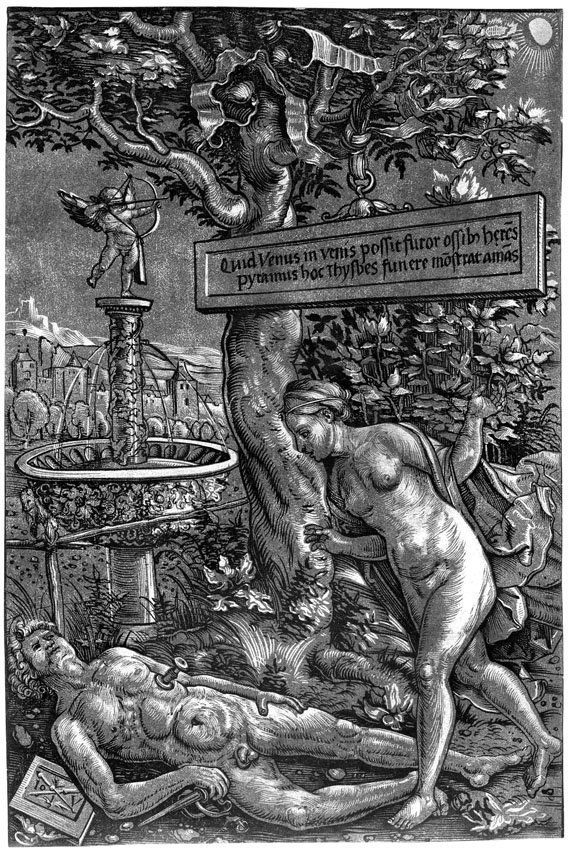
The following five names are from only two Nuremberg families, Wandereisen and Wechter. Hans Wandereisen deserves special attention for his role in the history of woodcut printing. He is one of the Formschneider, the scilled woodcutters, for which the free imperial city of Nuremberg was renowned. Emperor Maximilian’s vast woodcut projects, largely executed by Nuremberg artists and craftsmen, had led to a major upswing for talented craftsmen and artists of this particular art form. Wandereisen married Anna Resch, the widow of one of the Formschneider who had been directly involved in Maximilian’s Triumphal Procession. Through his marriage, Wandereisen also inherited Resch’s workshop. He republished woodcuts by his deceased predessessor, mostly broadsides, and printed his own works of the same type. The tasks of a head of such a workshop oscillated between the roles of Formschneider, printer, Briefmaler (i.e. colorist), and publisher of this kind of sheets. As the nature of the involvement cannot always be determined for every specific print, no effort has been made here to make the usual separation between the "inventor" and the "sculptor". Some bear the trademark of Wandereisen and to some his name is added in letterpress attesting to his publication of the sheet. His case is also interesting because his woodcuts of the castles destroyed by the Swabian League, a republication of an earlier work, was banned from sale by the city council. Nevertheless, it was sought after and one copy was owned by the humanist Willibald Imhoff.
The other printmakers listed, Johann Wandereisen and three members of the Wechter family, are etchers specialising in ornamental design. The printed work by Johann Wandereisen, a painter who may be a later descendant of Hans, consists of only a single, complex series illustrating the biography of Saint Augustine. Interestingly, his wife apparently assumed considerable financial responsibility. When Heinrich Ulrich moved to Vienna, she would still try to have him pay 200 guilders he owed Wandereisen. She also attempted to obtain the copper plates her husband had given to the city as surety.
A moving biographical detail about Georg Wechter the Elder is his suicide at his wife's grave. It is interesting to compare the Beschlagwerk style in his two beautiful series of designs with that of his namesake, two generations younger, in a style of grotesques. The more extensive series of the latter consists of illustrations for a book promoting the miraculous Virgin of the town of Weyer, now called Marienweiher near Bamberg, which was the center of a remarkable pilgrimage.
Hans Wechter the Elder, son of Georg Wechter the Elder, etched two large views of his hometown of Nuremberg from the east and west. Particularly noteworthy is his enormous view of Prague, more than 3 metres wide and printed from nine plates. This project, which Wechter executed in Prague after drawings by Philipp van den Bosche, was an undertaking of the publisher Aegidius Sadeler and thus testifies to the dense artistic atmosphere of the imperial city, where the collaboration of German and Netherlandish artists under the patronage of the imperial court resulted in outstanding works. Gero Seelig
Published in 2025
Compiler: Dieter Beaujean
Editor: Gero Seelig
ISBN: 978-94-835763-2-9
286 pp.